
Couples come to us for all kinds of reasons. A wedding is coming up, or an anniversary, or one of them has wanted to learn for years and finally talked the other into it. Almost nobody says they’re here to improve the relationship. But that’s usually what ends up happening, as a side effect, and it happens faster than you’d expect. Partner dance asks things of two people that everyday life rarely does, and a few weeks of it changes how a couple works together.
You have to pay attention to each other

Partner dance has a lead and a follow, and people hear that and wince. It sounds like a rule from an old etiquette book, one person in charge and the other going along.
On the floor it works differently. A good lead doesn’t shove anyone anywhere. The lead offers a suggestion through the frame of the arms and the shift of the body, and the follower reads it and answers with a movement of their own. The follower is doing plenty of work: keeping their own balance, tracking the music, and telling the leader through the connection when something feels off.
Here’s the part that matters for a relationship. For the length of a song, both of you are watching, feeling and responding to the other person the whole time. There’s no phone. There’s no half-listening while you think about tomorrow’s meeting. If your attention drifts, the dance falls apart within a few steps, and you both feel it.
Think about the last time the two of you gave each other three full minutes of undivided attention. Most couples have to think about that one for a while.
The decision-maker learns to hand it over
Most couples have a default arrangement, even if nobody ever named it. One of you plans the trips and picks the restaurants. The other says “wherever you want.”
Dance shakes that loose. Leading means making a decision and then communicating it clearly and gently enough that your partner can say yes. Grip too hard and they’ll tense up. Be vague and they won’t know where to go. Following means your response matters. When the follower doesn’t answer, the dance stalls and the leader has to adjust.
People who always make the decisions find out what it feels like to make one and hold it lightly. People who usually go along find out they have more say than they thought. Neither lesson stays on the dance floor.
You will bicker, so plan for it
Let’s be honest about this one. Nearly every couple hits a rough patch somewhere in the first few weeks. “You’re not following!” “You didn’t lead anything!” Voices take on that careful, level tone people use when they’re annoyed and trying not to show it.
The usual mistake is that each of you starts teaching the other. You can see exactly what your partner is doing wrong, and you can’t resist saying so. Within minutes the lesson has turned into a performance review, with you as the reviewer and your spouse as the employee who isn’t taking it well.
Our advice is simple. Let the instructor instruct. That’s why they’re in the room. A correction lands better coming from someone neutral, with no shared history attached. An instructor can also explain the same step three different ways until one of them clicks, which is more patience than most of us have for our own spouse. If you catch yourself about to coach your partner, bite your tongue and smile instead. It works more often than you’d guess.
It helps to remember that the step is hard for everybody. When it goes wrong, the problem is almost never your partner. It’s a new skill that neither of you has yet.
Both of you are bad at something
In most couples, one person is the competent one at most things. One handles the money and the other handles the car. One reads the map and the other reads the room.
On the dance floor, that arrangement collapses. You’re both beginners, both slightly awkward, both a half beat behind. For a lot of couples this comes as a relief. The person who’s never wrong about directions can’t pretend to know where the left foot goes either.
There’s something good in watching your partner be bad at something and keep going. It’s hard to see someone laugh at their own mistake, try again, and not feel a little affection for them. And you get seen doing the same thing, which takes some trust. In our experience, couples who’ve learned to look foolish together go easier on each other afterward.

You get a goal with a date on it
Plenty of couples come in because something is coming up. A wedding, their own or someone else’s. An anniversary. A cruise where the ship has a dance floor and they’d like to stay off the wall. A big birthday. A daughter’s wedding where the father of the bride would rather not shuffle in place.
A goal with a date changes how you practice. You stop wondering whether you should work on that turn and start working on it, because the day is getting closer and neither of you wants to be the reason it goes badly. Working toward something together, even something small, gives a relationship a kind of momentum that’s easy to lose when the days run together.
And then the day arrives, and you do it. You walk out on the floor, the song starts, and you’ve got something to show for the weeks of practice. That feeling of having pulled it off as a team is hard to get from most other things couples do.
A date night that isn’t dinner
Dinner and a movie has a built-in problem. You sit side by side facing a screen, or across from each other with a phone lying face down on the table, not really face down. It’s pleasant. It’s also forgettable.
A dance lesson is an hour on your feet in each other’s space, with your hands busy and your phone in your bag. There’s music, a bit of nerves, a lot of laughing. Afterward you’ve got something to talk about that isn’t the kids or the budget. You’ve got one move you can never quite get right, which turns into a running joke within about two weeks.
A standing weekly lesson gives you one more thing, and it’s easy to overlook. It’s an appointment. Something on the calendar that belongs to the two of you, that you both look forward to, and that doesn’t get bumped when work gets busy, because it’s booked and you’re both showing up. Couples who’ve been together a long time sometimes find the relationship runs almost entirely on logistics. A weekly lesson puts one thing in the schedule that exists purely for fun.
It follows you home
Something odd happens after a few weeks. You start practicing in the kitchen while the pasta boils. A song comes on in the car and one of you taps out the rhythm on the steering wheel and says “that’s a cha cha,” and the other one says “no, it’s a rumba,” and now you’re having a friendly argument about music instead of about whose turn it is to deal with the gutters.
Las Vegas also happens to be a great place to be a couple who dances. There’s live music, there are nights out where the floor is open, and there’s no shortage of weddings. Once you’ve got a few dances under your belt, a night out looks different. You’re not stuck at the table wishing you had the nerve. You walk over and dance.
Touch with a purpose
Most couples touch constantly in small, practical ways. A hand on the back while passing in the hallway, a kiss goodbye, a nudge on the couch. All good, all quick.
Partner dance builds in a different kind of closeness. You stand in a hold, one hand on a shoulder blade, the other clasped, and you stay there for the whole song, moving together. Some dances are slow and close. Rumba and bachata come to mind. Others, like waltz and foxtrot, are about gliding across the floor as one unit. Either way you’re trusting each other with your balance and giving each other your full attention, on purpose.
It doesn’t have to be romantic every time. Sometimes it’s two people trying to get through a turn without tripping. But after years of passing each other in the hallway, it’s easy to forget what it feels like to stand that close and move in sync.
When only one of you wants to go
This comes up all the time. One partner has wanted to learn for years, and the other is dragging their feet.
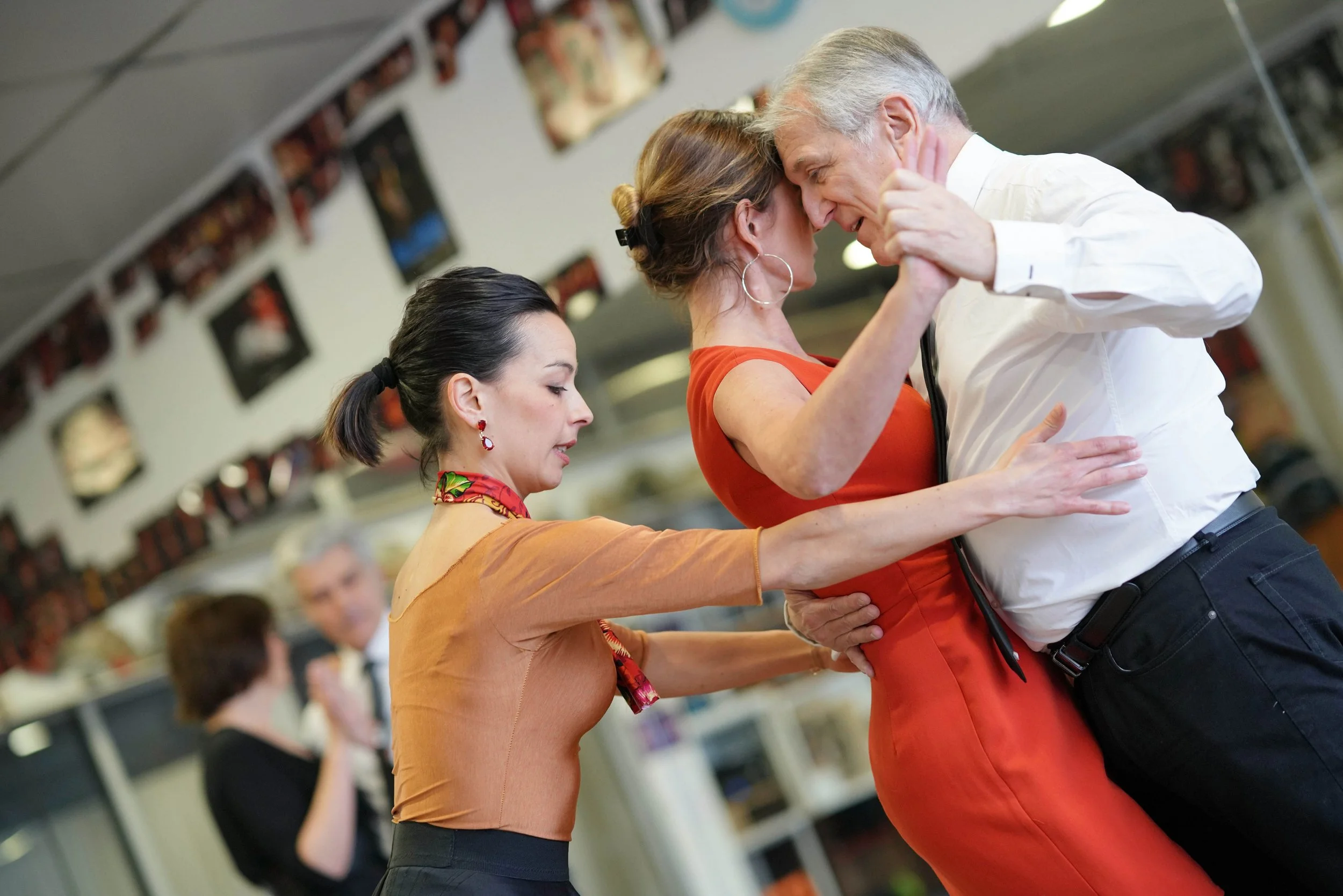
Usually the reluctant one is dreading looking foolish. If that sounds like your partner, two things are worth telling them. The only person watching is an instructor who has seen every beginner mistake there is and stopped being surprised by any of them years ago. And they don’t have to commit to anything. One lesson is enough to find out.
We back that up. At Vegas Ballroom Dance, every new student will be dancing the basics with the music by the end of their first lesson, or they get their money back. Our instructors are award winning dancers who have taught a lot of nervous beginners, and they know how to make that first hour easy. So the stakes for a skeptical partner are low. If they hate it, you’ve lost an hour.
Don’t guilt them into it and don’t bribe them. Ask for one lesson, and promise that if they really don’t like it, you’ll find something else to do together.
Picking a dance
We teach over a dozen partner dances, which is a lot to choose from. A few make good starting points for couples.
If you want something slow and close, try rumba or night club two step. Bachata is close too, with a gentle rhythm. If you like to laugh and play with the music, swing is great for that, and it gets better the more you dance together. Country two step is an easy one to take out on a night when you’re in the mood for country music. If you have a wedding coming up, or you’re planning a first dance, waltz and foxtrot are the classics, and our instructors can help you put something together that fits your song.
If the two of you can’t agree, pick one each and learn both. Pick whatever music makes you want to move. If you can’t decide, ask us and we’ll point you somewhere.
Come try it
Bring comfortable shoes. Leave your phone in your bag. If you step on a toe, laugh. That covers most of what you need to know for the first lesson. Book a first lesson at Vegas Ballroom Dance, bring your partner, and see what happens!
