
Which Ballroom Dance Should You Learn First?
There are five dances in the Ballroom category, and if you are just starting out, knowing where to begin can feel genuinely overwhelming. Each dance has its own character, its own technical demands, and its own learning curve. Some are welcoming to beginners. Others look approachable but will humble you quickly. And a couple are best left for later, once you have more experience under your belt.
This guide walks through all five and explains what makes each one easier or harder for a new dancer to pick up, so you can make an informed decision about where to put your energy first.
The Five Ballroom Dances at a Glance
The five dances in the Ballroom category are the Waltz, Tango, Viennese Waltz, Foxtrot, and Quickstep. Each one is distinct enough that your experience with one won't fully prepare you for another, but they do share common technical principles that make learning them in the right order a real advantage.
Waltz is the most iconic of the five. It moves across the floor in sweeping, flowing patterns, with couples rising and falling through each measure in a graceful three-beat rhythm. The tempo is gentle and the feeling is one of quiet elegance.
Tango is Waltz's dramatic counterpart. Where Waltz floats, Tango is grounded and deliberate. The steps are sharp and precise, the posture is proud, and the connection between partners is close and intentional. It has a reputation for being intense, but structurally it is one of the more straightforward dances in the group.
Viennese Waltz is the ancestor of the modern Waltz, and it moves at a considerably faster tempo. It is built almost entirely on rotating figures and covers the floor quickly. Beautiful to watch, but demanding to learn.
Foxtrot is a dance of continuous, seamless movement. At its best, it looks like two people simply gliding, every step flowing naturally into the next. It sweeps across the floor more than Waltz, but spins less, with long linear and arcing movements.
Quickstep is fast, bright, and athletic. It is related to Foxtrot in its technical foundations but due to the faster music it adds hops, runs, and sharp direction to liven up the feel. It is danced to big band music, and can have the feel of swing dancing at times.
The Best Starting Dances: Waltz and Tango
For most beginners, the two strongest entry points into Ballroom dancing are Waltz and Tango. They make good starting dances for different reasons, and either one will put you on a solid path forward.
Waltz: Start Here If You Want Smoothness
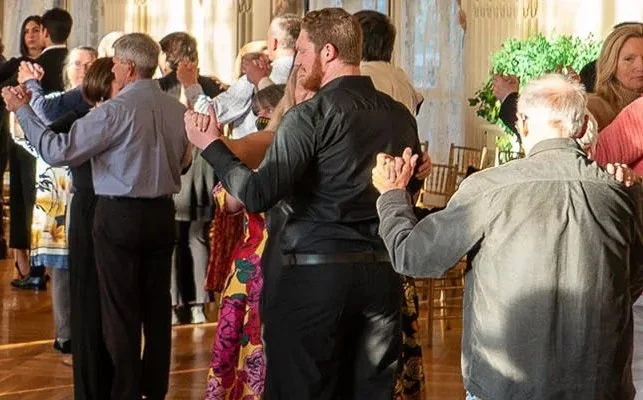
Waltz is one of the most common first dances, and a core ballroom dance
The single biggest advantage Waltz offers a beginner is its tempo. It is slow. That might sound like a small thing, but when you are just learning how to share your weight with a partner, coordinate your feet, maintain your posture, and listen to the music all at the same time, having a tempo that gives you room to think is genuinely valuable.
The three-beat rhythm of Waltz is also one of the most intuitive in music. The natural sway built into the phrasing helps new dancers connect with the musicality of the dance without having to consciously force it. Most people feel the pulse of a Waltz almost immediately, which gives lessons a momentum that faster, more complex rhythms do not always provide.
Beyond tempo and rhythm, Waltz builds foundational technique that carries into every other Ballroom dance. The concept of rise and fall, the mechanics of rotating figures, the development of a shared frame between partners: these are principles that appear throughout the discipline, and Waltz gives you the time and the space to actually develop them properly. When you learn these things in Waltz, you are not just learning one dance. You are building a body of knowledge you will draw on for years.
The footwork in Waltz is also broad and clearly defined, which makes it easier to develop good habits without being rushed. A beginner can focus on one element at a time, whether that is foot placement, timing, or connection, without feeling like the tempo is constantly outpacing their ability to process what they are learning.
Tango: Start Here If You Want Simplicity
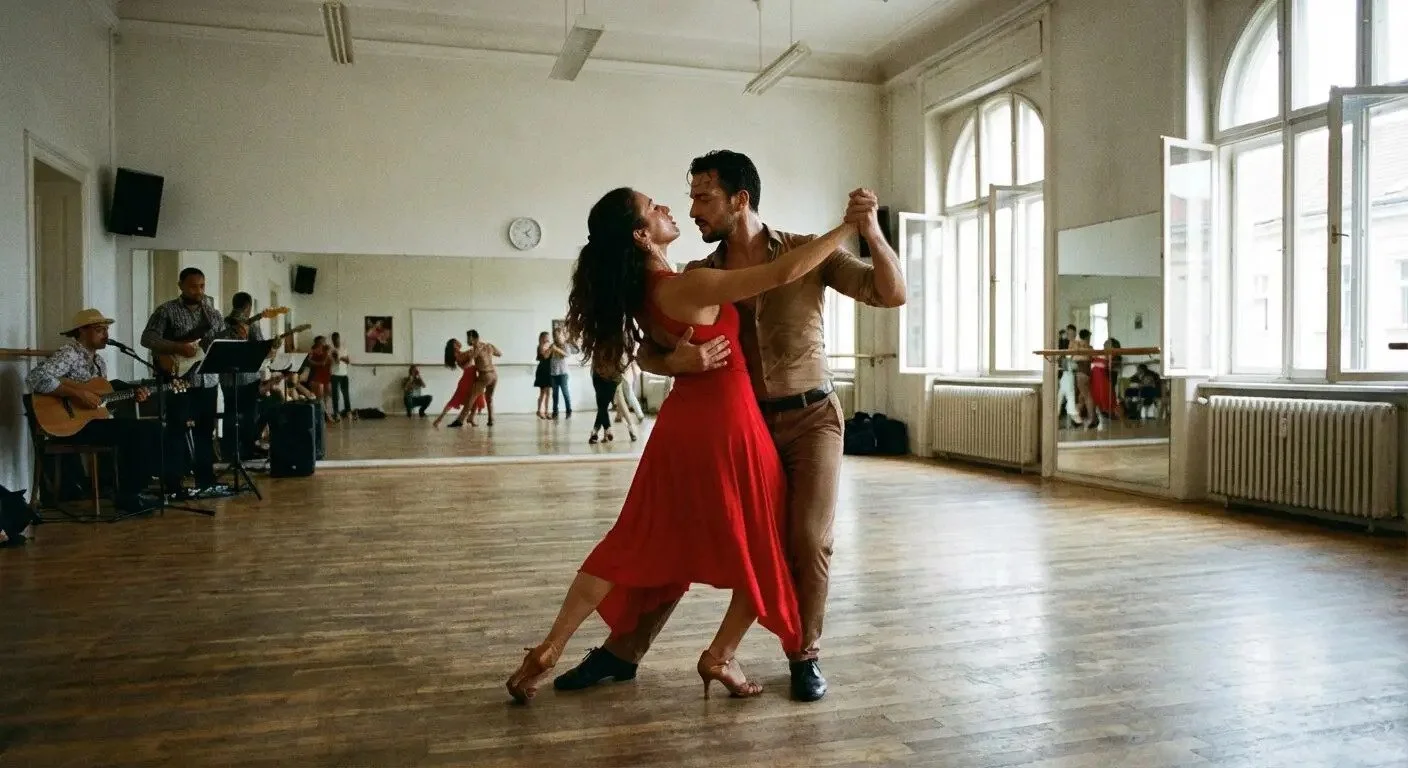
Tango is simple and easy enough to pick up in just one lesson
Tango surprises a lot of people who assume its dramatic reputation makes it difficult to learn. The character of the dance is intense, but the underlying structure is actually quite straightforward, which makes it a genuinely strong starting point for certain types of learners.
The rhythm in Tango is even and sharp, with a clarity that makes it easy to hear the beat and match your movement to it. Unlike Waltz, there is no rise and fall in Tango. Your body stays grounded throughout, with knees slightly flexed and weight settled. That physical consistency removes one layer of complexity that beginners in Waltz have to manage, and it gives new dancers a stable platform to work from.
The footwork patterns in Tango are compact and simple. Each step has a clear beginning and a clear end, which gives beginners a real sense of control over what they are doing. That deliberate quality, the sharp placement of each foot with intention, actually helps rather than hinders a new dancer. You always know when a step is finished, which is not always the case in more flowing dances.
Learning to move with that kind of purposefulness early in your training builds excellent habits. Precision and intentional weight transfer are skills that matter in every Ballroom dance, and Tango puts them at the centre of the learning experience from the very first lesson.
There is also a practical benefit worth mentioning. Tango does not require a lot of floor space to practise. Waltz is a travelling dance and benefits from a proper dance floor to move across. Tango's more contained figures can be worked on at home, in a living room or hallway, which is a genuine advantage for students who want to practise between lessons.
What About Quickstep?
Quickstep is an exciting dance, and it is a possibility to begin with. Some students are drawn to its energy and brightness right from the start, and a motivated beginner can make real progress in it.
The honest caveat is that Quickstep is fast, and tempo has consequences. Footwork errors that are manageable in Waltz become much harder to recover from when you are moving at Quickstep's pace. The athletic demands of the dance, including the quick spins, the rapid direction changes, and the need to stay consistently light on your feet, require a baseline of physical coordination that takes time to develop in any dancer.
There is also a strong technical argument for learning Waltz before Quickstep. The two dances share a lot of technique. Their footwork patterns share significant overlap, and the body mechanics developed in Waltz transfer directly and immediately to Quickstep. A student who comes to Quickstep having already spent time in Waltz will reach a higher level of Quickstep, and reach it faster, than one who tried to skip that step. If Quickstep is ultimately where you want to go, Waltz is genuinely the most efficient route to get there.
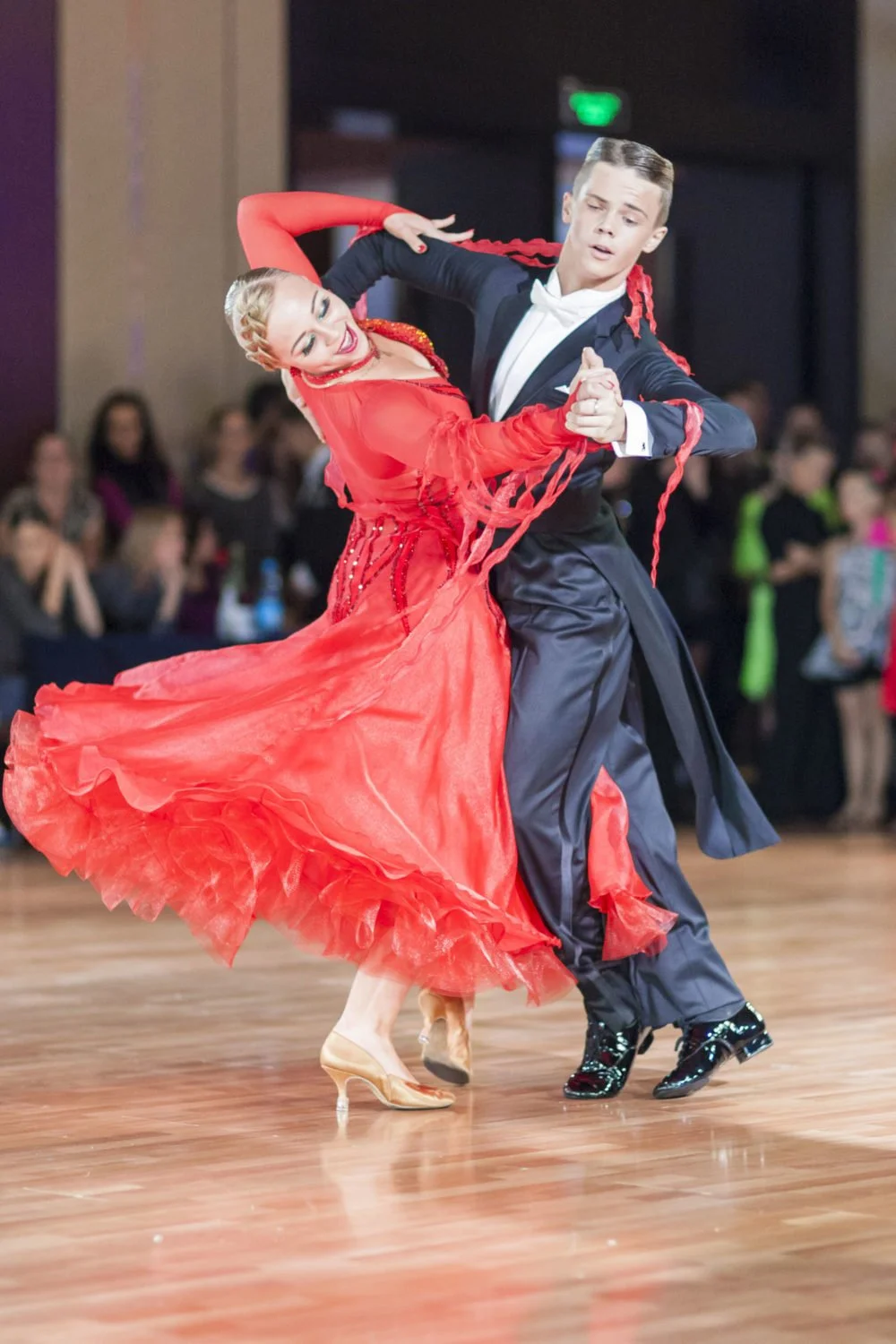
Foxtrot and Viennese Waltz require a lot of coordination and practice
Why Foxtrot Is Best Saved for Later
Foxtrot is a dance that consistently surprises beginners with how technically demanding it is. From the audience, it looks smooth and almost casual. On the floor, it requires a degree of full-body coordination that is more involved than almost any other dance in the Ballroom category, and that difficulty begins at the very first step.
The challenge is that Foxtrot does not allow you to isolate one technical element at a time. To produce even a basic Foxtrot movement correctly, multiple things have to work together simultaneously: the footwork, the body sway, the rotation, the connection with your partner, the timing within the music, and the continuous, unbroken flow across the floor. In most dances, a beginner can focus on one of these things at a time and gradually layer in the others. In Foxtrot, they are all interdependent in a way that makes that process very difficult. Isolating one element tends to break the others.
Even the most basic footwork in Foxtrot involves a nuanced relationship between the foot, the ankle, and the floor that takes time to develop. The body also has to absorb and redirect momentum in a specific way to create that characteristic smooth quality. Without that technique in place, Foxtrot tends to look and feel choppy, which can be frustrating for a beginner who is working hard and not seeing the results they expected.
None of this means Foxtrot is off limits for a new dancer. A skilled teacher can simplify the material, build it carefully from the ground up, and give a motivated beginner a real experience of the dance. It just requires more patience and a more careful approach than starting with Waltz or Tango. Most dancers who truly love Foxtrot will tell you it wasn’t the first dance they learned.
A Word on Viennese Waltz
Viennese Waltz stands apart from the other four dances in one important way: we do not recommend learning it until you have worked through the others. That is not a knock against it. Viennese Waltz is one of the most visually stunning dances in the Ballroom category, and experienced dancers find it deeply satisfying. But it is a dance that demands a strong foundation, and trying to build that foundation in Viennese Waltz itself is an uphill battle.
The tempo is the core issue. Viennese Waltz moves faster than any of the other four dances, and because it is built almost entirely on rotational figures, there is very little opportunity to pause or reset if something goes wrong. In Waltz, a hesitation or an imperfect step is something you can absorb and move on from. In Viennese Waltz, the momentum of the dance does not give you that grace. Small problems compound quickly when you are rotating and travelling at that speed.
The technical demands of Viennese Waltz are also unforgiving in a way that rewards dancers who have already developed their body mechanics elsewhere. By the time you have worked through Waltz, Tango, Foxtrot, and Quickstep, many of the skills Viennese Waltz requires will already be part of how you move. Coming to it with that background makes the learning process dramatically more manageable, and the experience of dancing it dramatically more enjoyable.
Making the Decision
If you are still weighing Waltz against Tango, think about the kind of learner you are.
Waltz suits people who need time to think, but are comfortable using more parts of their body. The slower tempo gives you room to process, and the foundational technique you develop will serve you in every other dance you learn.
Tango suits people who want fewer things to think about, but are comfortable doing those things faster. If you find flowing, continuous styles harder to connect with, the sharp and grounded quality of Tango may feel more natural.
Either way, the dances inform each other. Students who begin with Waltz often develop a strong appreciation for Tango once they move into it, and vice versa. Progress in one genuinely accelerates progress in the other, and both lead naturally into the rest of the Ballroom syllabus.
The Bottom Line
Waltz and Tango are the two best starting points for a beginning Ballroom dancer. Waltz offers a forgiving tempo, an intuitive rhythm, and a wealth of foundational technique that will benefit every dance you learn afterward. Tango offers a clear, straightforward structure, a grounded and precise movement quality, and a strong platform for developing good habits early.
Quickstep is a reasonable option for a motivated beginner, but its tempo is demanding, and the technical groundwork laid in Waltz will make you a better Quickstep dancer when the time comes. Foxtrot can be approached with care and the right teacher, but its coordination demands make it a challenging place to start. Viennese Waltz is genuinely best saved for after you have developed your foundation in the other four.
Start with Waltz or Tango. Build carefully. The other dances will be waiting for you, and you will be ready for them.
